





Amino acids help your body build and repair muscle. The useful question is whether an amino acid supplement adds something your current diet is missing.
If you train regularly, understanding essential amino acids, BCAAs and protein can make the supplement shelf much less confusing. Here’s how they fit together, what the evidence supports and where an amino drink may be practical.
What are amino acids?
Amino acids are the building blocks of protein. Your body uses them to make and maintain tissues, including muscle, as well as many enzymes and other important compounds.
Nine are essential amino acids (EAAs), meaning they must come from your diet: histidine, isoleucine, leucine, lysine, methionine, phenylalanine, threonine, tryptophan and valine.
Three of these, leucine, isoleucine and valine, are the branched-chain amino acids (BCAAs). BCAAs are part of the EAA family, not a separate set that needs to be added to make twelve.
How do amino acids support muscle growth?
Resistance training provides a stimulus for adaptation. Amino acids provide material for making new muscle proteins, a process called muscle protein synthesis.
Leucine helps activate the signalling involved in this process, but a signal is not enough on its own. The body needs the other essential amino acids too. This is why the full amino acid supply matters more than chasing a particularly high leucine ratio. Review of BCAAs and muscle protein synthesis.
Free-form EAA supplements can stimulate muscle protein synthesis. That is a useful physiological effect, but a short-term response is not the same as proof that adding a drink will produce more muscle over months in someone already eating enough protein. Training quality, total food intake and recovery remain central. ISSN position stand on essential amino acids.
EAAs, BCAAs or protein powder?
- Protein-rich foods: provide amino acids along with other nutrients. Varied meals are the foundation.
- Protein powder: supplies protein that your digestive system breaks into amino acids. It can help fill a gap in your daily protein intake.
- EAA supplements: supply the nine essential amino acids in free form, often in a lighter flavoured drink.
- BCAA-only supplements: supply just three essential amino acids. They should not be treated as equivalent to all nine EAAs or a complete protein source.
A protein shake and an EAA drink are different options, not compulsory partners. If your meals and protein powder already provide enough high-quality protein, the extra benefit of adding amino acids is less certain.
Can amino acids reduce muscle soreness?
Some studies and reviews of BCAA supplementation report lower soreness after muscle-damaging exercise. Results vary with the participants, exercise session and supplement protocol. Systematic review of BCAAs, soreness and muscle-damage markers.
Less soreness does not necessarily mean greater muscle growth, faster tissue repair or improved performance in your next workout. It is also not a promise that every product or serving will reproduce a study’s results.
Avoid using soreness as your only recovery score. Sleep, appetite, training performance and how manageable your overall workload feels are useful context too.
What about preserving muscle while dieting?
When reducing energy intake, keeping resistance training and sufficient dietary protein in place helps support lean tissue. Amino acids are not a fat-burning shortcut, and a small amino drink does not replace a balanced meal.
The practical priority is to plan enough protein across your food intake, rather than assuming a supplement will protect muscle regardless of how little you eat. Athletes managing weight should seek individual advice, particularly for weight-class sports.
When might an EAA drink be useful?
Convenience is a reasonable reason to choose one. An EAA drink may suit someone who prefers a light drink near training, has difficulty eating immediately around a session or wants an alternative to a milky shake.
It should still fit an adequate daily diet. For long or demanding sessions, amino acids do not replace the carbohydrate needed for fuel, or an appropriate fluid plan.
Start by asking:
- Am I eating enough overall?
- Do my meals provide enough protein?
- Would a meal or protein shake meet this need just as well?
- Does an amino drink solve a genuine practical problem for me?
The AIS recommends a food-first approach and choosing protein supplements around the athlete’s actual needs and circumstances. AIS protein-supplement guidance.

What’s in Organic Performance Amino Acids?
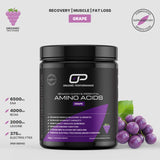
Organic Performance Amino Acids is a fermented EAA formula that includes all nine essential amino acids. Its BCAAs are supplied in a 2:1:1 ratio of leucine to isoleucine and valine.
The current Grape nutrition panel lists the following per 10-gram serve of powder:
- 2 grams leucine
- 1 gram isoleucine and 1 gram valine
- 2.5 grams of the other six EAAs combined
That is 6.5 grams of listed EAAs in 10 grams of powder, not 10 grams of pure amino acids. The formula also contains flavour ingredients and minerals. Check your chosen flavour’s current label for the full details.
The ratio describes the formula; it does not establish that it is uniquely optimal or that the finished product has been clinically proven to produce specific results.
When should you take amino acids?
There is no single timing rule that makes a supplement essential. Consider when you last ate, when your next meal is and what your training involves.
If you use the OP product, follow its current directions: one 10-gram scoop mixed with 600–800 mL of water. Treat that as a product serving, not a universal research dose. There is no need to stack multiple amino products simply to chase more.
What should you check before buying?
- Whether the formula includes all nine EAAs or only BCAAs
- The amounts of actual amino acids, not only total scoop weight
- Ingredients, allergens and individual tolerance
- How the cost compares with meeting the same need through food
- Relevant batch certification if you compete in tested sport; heavy-metal testing is not the same as banned-substance certification
The bottom line
Amino acids are essential to muscle growth, but an amino acid supplement is not essential for everyone. Build the foundations first: consistent resistance training, enough food and protein, and proper recovery.
An EAA drink can be a convenient option when it fits your routine. Choose it with realistic expectations and a clear understanding of what is in the scoop. Explore Organic Performance Amino Acids and view the full label.
This article provides general information for adults. Speak with an Accredited Practising Dietitian or treating clinician if you have a medical condition or need personalised nutrition advice.